

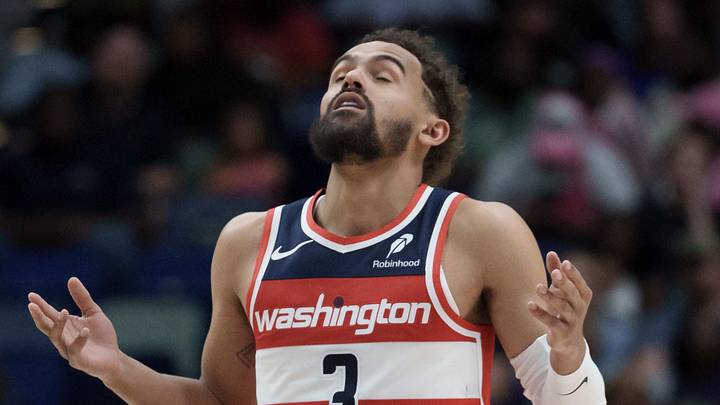
The Atlanta Hawks traded franchise player Trae Young to the Washington Wizards in a bold January shakeup. The decision spawned a massive in-season turnaround, with the Hawks ultimately making the playoffs behind a well-rounded effort from a remarkably balanced rotation.
With the 2026 NBA Draft approaching, however, a question persists: Who will replace Young as the franchise point guard? Thankfully, there are five intriguing options to consider.
The list could've been longer, but a recent report indicates that Mikel Brown Jr. and Keaton Wagler will be off the board by No. 8. If that proves to be the case, then the Hawks will need to look at a different collection of players—including those who may be available further down the board.
Thankfully, the Hawks still have a surplus of options to consider for the job of replacing Young as the franchise point guard.
1. Darius Acuff Jr., Arkansas Razorbacks
Among the point guards on the board, few are quite as fascinating on offense as Darius Acuff Jr. of the Arkansas Razorbacks. He's faced his share of questions and concerns about his defense, but he has advanced processing speed and an elite skill set as a scorer and playmaker.
If the goal in replacing Young is to find an offensive dynamo who can replicate his scoring and playmaking proficiency, then Acuff may be the best option on the board.
As a true freshman in a top conference, Acuff was genuinely unguardable. He averaged 23.5 points, 6.4 assists, 3.1 rebounds, 0.8 steals, and 2.5 three-point field goals made per game, shooting at a mind-blowing clip of .484/.440/.809.
With limitless range on his jump shot, elite handles, top-tier court vision, and the advanced IQ that allowed him to commit just 2.2 turnovers per game, Acuff has superstar potential on offense.
In Atlanta, Acuff's ability to play both with and without the ball would make him a dream fit alongside Jalen Johnson. He can create for his teammates, play off of them when they isolate their defenders, and balance his scoring and playmaking with the needs of the team.
Acuff needs to improve defensively if he wants to win in the NBA and fit Atlanta's system, but his 6'6.5" wingspan and blazing speed should help him defend at a plus level if he commits himself to doing so.
2. Christian Anderson, Texas Tech Red Raiders
Christian Anderson could fall just between the Hawks' two first-round picks. In saying that, Atlanta should at least consider him—with both of their available picks, depending on how the cards fall. If nothing else, he has the shooting range, athleticism, and playmaking proficiency to fit their system.
Anderson is arguably the best passer in this class, as well as an excellent shooter whose 6'6.25" wingspan and 40.5" vertical have quieted concerns over his height at 6'1".
Anderson is a pick-and-roll maestro who has proven capable of working with athletic big men and sharpshooting wings alike. He's also a tremendous three-point shooter with deep range who can space the floor with his mere presence on the court.
In 2025-26, he averaged 18.5 points, 7.4 assists, 3.6 rebounds, 1.5 steals, and 3.3 three-point field goals made while shooting at a clip of .472/.415/.805.
The reason Anderson makes more sense at No. 23 than No. 8 is that he may not be quite the inside finisher Atlanta needs. He has the tools to become a strong defender but there are at least some concerns over how he'll fair on that end of the floor, as well.
Nevertheless, if Anderson is available in the range of the Hawks' second first-round pick, then he could be an excellent structural fit with untapped potential.
3. Kingston Flemings, Houston Cougars
Arguably the best defender among this group of players, Kingston Flemings plays far bigger than he measures. That may not necessarily dissuade skeptics' concerns, but it should poke holes in the theories that he's too small to succeed in the NBA.
Standing at 6'2.5" without shoes with a 6'3.5" wingspan, Flemings has the offensive skill set and defensive determination to fit wonderfully alongside the Hawks' core players.
One of the primary reasons Flemings is able to overcome the concerns about his lengths is that he's a magnificent athlete. He boasts a 40.5" max vertical leap and ranked No. 1 or No. 2 amongst point guards in every single strength and agility drill at the 2026 NBA Draft Combine.
Not to be confused with a player who's simply athletic, Flemings is a capable shooter and impressive playmaker who limits mistakes and keeps the floor spcaed.
Flemings will need a bit of time to adapt to the NBA, particularly when one considers that he's a low-volume shooter who's prone to inefficiency within the three-point line. There are clear signs of potential in every phase of the game, however, and Atlanta is an ideal team to help him refine his skill set.
For a Hawks team that would find instant value in a point guard who can defend, dribble, shoot, and pass, Flemings certaily seems to fit the team's needs.
4. Ebuka Okorie, Stanford Cardinal
Ebuka Okorie's projected range at the 2026 NBA Draft has gone anywhere from the top 20 to the late 20s. One way or another, the Hawks should give serious consideration to selecting the Stanford Cardinal star as their point guard of the future.
In a class full of top-level point guards with similar profiles and slight differences that define their individuality, Okorie is cut from a different cloth—and offers something Atlanta needs.
Okorie is a downhill player who can get into the paint and finish amongst the trees. He's by no means the only player who does so, but while others add drives to balance out their jump shooting, Okorie has the tools and inclinations to get into the paint and draw contact.
That helped Okorie attempt 7.3 free throws per game. When teams closed those driving lanes off without fouling, he happily buried 2.0 threes per game while adding midrange magic.
Okorie's 23.2 points per game led all ACC players—quite a feat for a freshman guard. His playmaking is admittedly still a work in progress, but isn't an egregious issue in a Hawks offense that features a surplus of playmakers and shot creators.
Compounded by the fact that Okorie boasts a massive 6'7.75" wingspan and a 37.5" vertical, his downhill style and defensive potential make him an excellent option for Atlanta to consider.
5. Labaron Philon Jr., Alabama Crimson Tide
From a pure scoring perspective, there may not be a better guard in this class. I'm admittedly higher on Labaron Philon Jr. than most, but he has the electric three-level scoring ability and versatility that teams dream of drafting. The hurdle in taking a chance on him at No. 8, however, is that he has quite a thin frame.
Thinner guards tend to struggle on defense in the NBA, but if the Hawks believe they can help Philon bulk up, then they'd have a dream fit alongside Nickeil Alexander-Walker and Dyson Daniels.
Philon is a tremendous ball handler who can get to his spots no matter how great the defenders in front of him are. Once he does, he can convert with efficiency—whether that be on three-point shots, midrange jumpers, or acrobatic layups around the rim.
Philon is also an excellent passer with the court vision and patience to run an offense. The reason he's so appealing for Atlanta: He's worked hard to be able to play away from the ball, as well.
Philon shot 31.5 percent from beyond the arc during his freshman season. He made a deliberate effort to improve his off-ball movement and shooting once the season concluded, however, and he came back to shoot 39.9 percent from three-point range as a sophomore.
There are question marks about Philon's strength and how that may limit him as a defender or perhaps even as a slasher, but he has the skill set to be a sensational NBA player.
 Add us as a preferred source on Google