

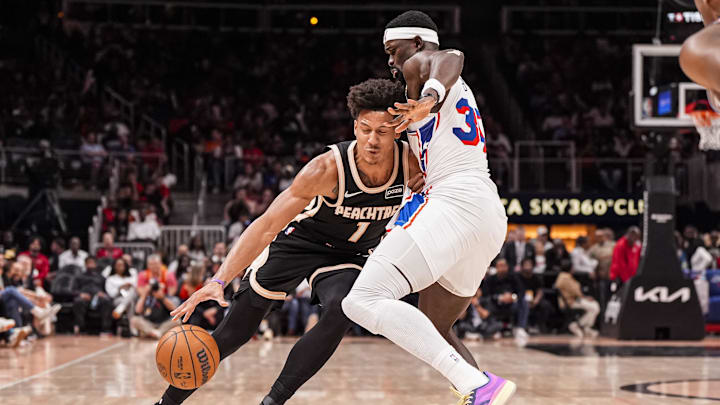
"Iso, Iso!"
One of the most famous play-calls in NBA history, headlined by legends such as Michael Jordan, James Harden, and the late, great Kobe Bryant, has left an indelible mark on the sport.
Watch (or play in) any instance of driveway hoops, and you'll run into fans who aspire to be like any of the three above names (or others) who have an elite isolation game. Perhaps nothing is more satisfying than beating your defender off the dribble, and either scoring with a tough finish at the rim or drilling a contested step-back three in tight airspace.
Iso's are just flat-out cool. Who doesn't love seeing Kobe's signature isolation signal en route to a post-up bucket, LeBron's clear-out hand motion, or even Luka Doncic (a la James Harden) slowly lull his defender into a state of stasis before nailing a three over his head?
Satisfaction and cool factor aside, however, the numbers tell a story far different from what many fans would have you believe. Isolations are actually the worst offensive actions in the sport, especially for players who aren't MJ, LeBron, Kobe, Harden, or Luka; players like Jalen Johnson, unfortunately.
Jalen Johnson's poor isolation scoring demands a new direction for the Hawks
Jalen Johnson, despite his overall success this season, especially as a point forward, is absolutely not cut out to be a high-volume isolation scorer.
The good news: Quin Snyder is well aware of this, as he's limited Jalen to just under two isolation possessions per game. The Hawks have performed as much more of a team-first, collective scoring effort since Trae Young's departure, as they most certainly should continue to do.
The bad news: Johnson is the 2nd-worst in the NBA among players with at least 100 isolation possessions this season, with a dismal 34.1 FG% and a 0.73 PPP (points per possession).
The answer: going back to the post?
So if isolation scoring isn't as good as it's cut out to be, where do we go?
Perhaps the post was always the answer. In renowned NBA podcaster Michael MacKelvie's recent analysis, two might be more than three, especially in the post.
MacKelvie breaks down how the post has been forgotten, and with the 3-point revolution, floor spacing has opened up the post for those wise enough to realize it.
Without as many help defenders with the ability to double a backdown, post savants like Jokic and Embiid can operate with the highest degree of success, often blowing isolation efficiencies out of the water (Jokic is averaging 1.16 PPP in the post this year on extremely high volume, even while dealing with injury!).
If you have the time, I'd highly recommend watching the ~20-minute video in full; it's a fun deep dive that I wager many of you would enjoy (especially if you miss the post-up that dominated the game in the 90's-00's)!
Johnson himself has demonstrated (albeit in a limited sample size of 1.1 possessions per game) a vastly improved scoring efficiency from iso to the post. Compared to his dull 0.73 PPP in isolation, he's averaging a solid 1.08 PPP in the post, good for 25th in the league amongst players averaging at least 1 post-up per game.
I'm not arguing for Coach Snyder to use Johnson as a mini-Jokic, but, as MacKelvie states, a bit more post play should be utilized, especially for players as strong and as court-savvy as JJ is.
If the Hawks can continue their recent elite stretch of games, don't be surprised if Johnson gets a few more post touches in a potential playoff setting. He's certainly earned it with his limited yet vastly more efficient success in that area thus far this season.
 Add us as a preferred source on Google