

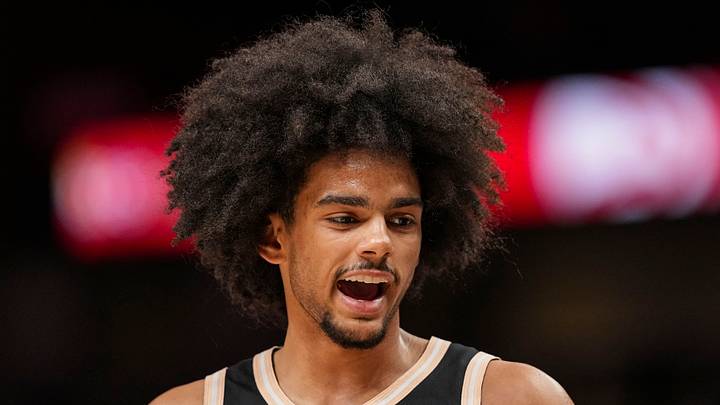
The Atlanta Hawks checked several important boxes by trading for veteran forward Dorian Finney-Smith. For one, they added size and defense to a guard-heavy second unit. They also created potential financial flexibility by acquiring Finney-Smith's contract, which includes a non-guaranteed 2027-28 salary.
The most important long-term takeaway from the Finney-Smith trade, however, may be how he can help mentor Asa Newell and set an example for the type of player the second-year forward can become.
Finney-Smith is preparing for his 11th NBA season. That alone is a testament to the type of success he's experienced, as he's found a steady place in the NBA as a committed defender, capable floor-spacer, and unselfish team player.
Willing and able to defend players at any number of positions, Finney-Smith has secured consistent paychecks and played meaningful minutes by doing the little things
That may very well be the path that Newell will need to follow if the Hawks don't intend to position him to play like a star. The odds of the latter outcome are low in the short-term considering Atlanta's frontcourt already has two high-usage players in All-NBA forward Jalen Johnson and starting center Onyeka Okongwu, and the perimeter is flush with guards who can create for themselves and others.
Thankfully, Finney-Smith should be able to set the perfect example for Newell as the second-year player searches for ways to carve out his own place as a rotational mainstay.
Asa Newell should follow in Dorian Finney-Smith's footsteps
Finney-Smith entered the NBA with a faulty jumper, but ultimately carved out a place as one of the most respected 3-and-D players in the Association. Between 2019-20 and 2024-25, he shot 37.7 percent from beyond the arc while consistently ranking among the best defensive wings.
In 2024-25, Finney-Smith shot 41.1 percent from three-point range and ranked in the 98th percentile in perimeter isolation defense, the 91st percentile in off-ball chaser defense, and No. 1 in the NBA in defensive positional versatility, per Basketball Index.
It's admittedly unfair to set such a high standard for Newell, who was selected at No. 23 overall in 2025 and is still just 20 years of age. What he can learn from Finney-Smith, however, is how to put his physical gifts to use on defense and how to scale his efficiency as a shooter—the latter of which he's already begun to do.
Newell, like Finney-Smith, was a poor shooter coming out of college. He buried 0.7 threes per game and 2.1 per 36 minutes as a rookie, however, shooting 38.7 percent from beyond the arc.
Dorian Finney-Smith made his name through defense
On the other end of the floor, Newell's defensive versatility was a big reason the Hawks drafted him. He stands at 6'9" with a 6'11.25" wingspan, and is an impressive athlete whose quickness enables him to switch freely along the wings. The question, of course, is whether or not he can refine his raw tools and turn them into reliable attributes.
In 2025-26, Newell showcased the ability to excel as a help defender, much as Finney-Smith has been able to, but he struggled mightily in isolation.
Newell minutes were admittedly limited, and he was a first-year player adjusting to the pace of the NBA game. As he carves out his own path in the Association, however, defense will need to be a part of what he brings to the table—particularly on a team that already has a high-usage forward in Johnson.
If Newell can learn from Finney-Smith and pattern his game after the veteran's, then the Hawks could have a long-term piece of the puzzle who makes an impact on both ends of the floor. From there, it'd all be a matter of growth as a player.
 Add us as a preferred source on Google