

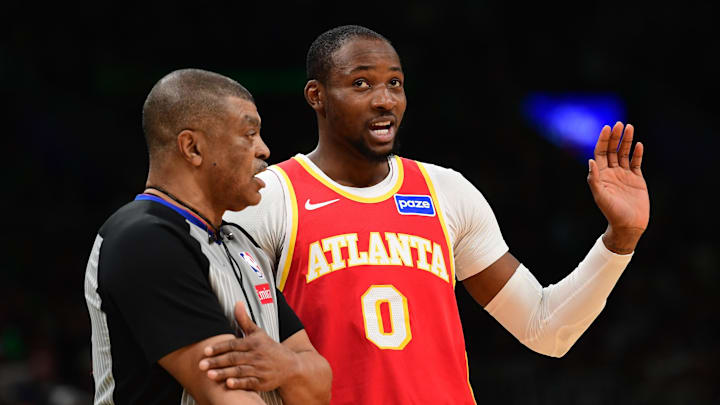
The Atlanta Hawks made a big splash during the NBA's midseason shuffle when they shipped off their newly acquired center, Kristaps Porzingis, to the Golden State Warriors in return for Jonathan Kuminga and Buddy Hield.
So far, the trade has worked in the Hawks' favor, as they've gone 19-3 down the stretch since the All-Star Break. Kuminga, who was the focal point of this trade, has carved out a meaningful role in the Quin Snyder offense, offering defensive versatility, rim defense, and productive offensive output depending on the night.
However, while momentum seems to be on Atlanta's side thus far, Kuminga's inconsistencies on the offensive end could be the Achilles' heel that can derail a potential playoff push.
Hawks need Kuminga to find his footing
In the last month, Jonathan Kuminga has had some impressive outings. He had 27 points in his Hawks' debut against the Wizards, 20 points against the Trail Blazers on March 1, and 16 points against the Mavericks on March 18. But sprinkled in between those solid outings have been lackluster scoring nights that are hard to ignore.
Without those three stand-alone performances, Jonathan Kuminga would be averaging less than seven points a game, not an ideal ROI after letting an All-Star center walk out of the building.
For a Hawks team that is rapidly climbing up the Eastern Conference rankings, the key to keeping this momentum on the upward trajectory would be to mitigate these inconsistencies as best as possible. Once the playoffs roll around, the teams that go the farthest are the ones with a reliable core of starters.
While Jonathan Kuminga has been a major catalyst for the Hawks' late-season success, this team will not find playoff success if they can't receive reliable and consistent production from their top guys. Especially for Kuminga, whom the Hawks traded a respectable amount for, they can't afford to have him become invisible in key moments, but the silver lining is this: it's not something that can't be fixed.
Kuminga's offense can be an X-factor
For starters, Kuminga must refine his offensive playmaking skills. A lot of the time, when Kuminga enters a slump, it stems from him drifting out of the offensive flow and forcing contested shots, so focusing on taking valuable shots within the offensive system would likely improve team continuity.
Secondly, Kuminga must be louder with the impact that he's already making. As an already established defensive threat and a respectable force on offense, contributing outside of your normal realm of ability is exactly what Kuminga can do to make his impact be felt across every phase of the game.
Finally, Kuminga's biggest issue seems to be a confidence problem. More often than not, when he's seeing his first couple shots go in, he's been far more prone to make plays at this same level of output throughout the game. However, when those first couple shots aren't falling, Kuminga almost phases himself out of the offense. The more defined Kuminga's responsibilities become, the more effective he becomes at making an impact within these responsibilities.
If Kuminga is able to rise above these inconsistencies, he has the opportunity to evolve from a respectable role player to a postseason hero come playoff time. For now, Atlanta looks to have won this trade on paper, but their postseason success is largely dependent on whether or not Kuminga is able to translate these flashes of talent into sustained, impactful production.
 Add us as a preferred source on Google