

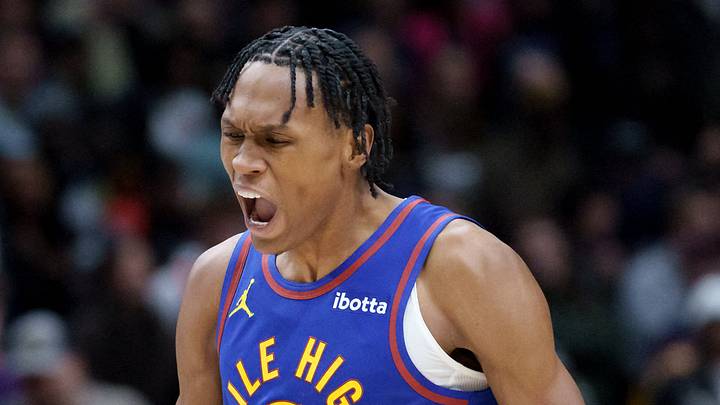
The Peyton Watson saga has finally reached its conclusion, and the Atlanta Hawks should feel comfortable about staying out of the bidding war.
ESPN's Shams Charania reported that Watson is heading to the Cleveland Cavaliers as part of a three-team deal involving the Denver Nuggets and Los Angeles Clippers, ending weeks of speculation surrounding one of the offseason's most intriguing restricted free agents.
Cleveland paid a substantial price to make it happen. The Cavaliers surrendered their 2031 first-round pick and a 2032 second-round pick via the Sacramento Kings while also agreeing to sign Watson to a four-year, $88 million contract. For a Hawks team that had previously expressed interest in Watson, matching that level of investment would have required a serious commitment.
Watson certainly would have been a nice addition to Atlanta's rotation, especially because of his defensive versatility, athleticism and continued development. However, there is a significant difference between liking a player and believing he is worth sacrificing premium draft capital while committing $88 million over four seasons.
BREAKING: Cleveland, Denver and the Clippers have agreed on a trade sending Peyton Watson to the Cavaliers, Max Strus to LA, and an unprotected 2031 Cavs first-round pick and a 2032 Kings second-rounder to the Nuggets, sources tell ESPN.
— Shams Charania (@ShamsCharania) August 19, 2026
Watson will sign a new four-year, $88… pic.twitter.com/hXqL3JvsU4
Watson's price became too expensive for Atlanta
President of Basketball Operations Onsi Saleh has consistently preached patience, flexibility and strategic roster construction since taking control of the front office. Giving up a future first-round pick and then committing approximately $22 million annually to Watson would have represented one of Atlanta's largest investments of the offseason.
That becomes even harder to justify when considering the Hawks declined Jonathan Kuminga's $24.3 million team option earlier this offseason. If Atlanta was unwilling to retain Kuminga at that number, paying Watson only slightly less annually while also sacrificing valuable draft compensation would have required Saleh to believe Watson represented a significant upgrade.
That is not to suggest Watson isn't worth Cleveland's investment. He is still a young and talented forward who could become an important piece for the Cavaliers, and his defensive versatility should provide immediate value. Cleveland simply appears to value him enough to accept the financial and asset cost necessary to acquire him.
Atlanta did not need to share that evaluation. The Hawks already strengthened their wing rotation considerably by acquiring Lu Dort and Aaron Wiggins from the Oklahoma City Thunder, giving Quin Snyder two more experienced two-way players without forcing the organization into the same level of long-term commitment.
With reports also suggesting Atlanta may be prepared to move on from Kuminga, adding Watson would have created another major investment at an already crowded position. Instead, Saleh can preserve those resources for a future opportunity that could have a much greater impact on Atlanta's championship ceiling.
Saleh's patience could eventually pay off
The Hawks have improved significantly throughout the offseason while still preserving the flexibility Saleh has repeatedly emphasized. That balance gives Atlanta room to stay competitive now without sacrificing the ability to pursue a more impactful opportunity later.
Atlanta does not need to make another move simply because one is available. There comes a point during roster construction when patience becomes just as important as aggression, especially for a team that believes it is building toward something bigger rather than attempting to complete everything in one offseason.
A future first-round pick could become particularly valuable if a legitimate star eventually hits the trade market. Atlanta could include that asset in a larger package, use it to acquire another rotation piece or simply retain it as part of the organization's long-term pipeline.
The same applies to financial flexibility. Committing $88 million to Watson would have reduced Atlanta's ability to maneuver in future offseasons, and that matters for a franchise still searching for the move that could eventually elevate the roster from a strong playoff team into a legitimate championship contender.
Watson would have made the Hawks better, but Atlanta has reached a stage where simply getting better should not be the only standard used to evaluate a transaction. Saleh must determine whether each significant investment moves the Hawks meaningfully closer to competing for a championship or unnecessarily limits their options for something bigger.
Cleveland decided Watson was worth the price, and that decision could ultimately work extremely well for the Cavaliers. Atlanta choosing a different path does not mean the Hawks missed an opportunity; it means Saleh remained disciplined enough to avoid paying a price that did not align with his vision.
The Hawks have already upgraded their roster and have little reason to force another major transaction. Unless an opportunity becomes available that significantly raises Atlanta's ceiling without compromising its future, staying the course may be exactly what this team needs.
 Add us as a preferred source on Google