

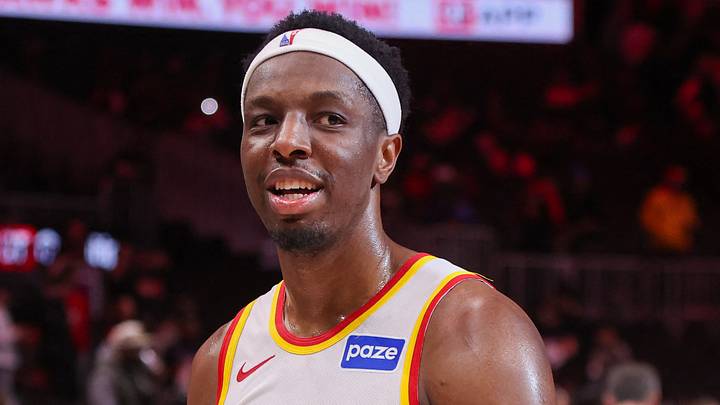
Onyeka Okongwu is entering his seventh NBA season, and the Atlanta Hawks have watched him gradually expand his game throughout his career. He entered the league as an athletic, high-energy big man who could defend multiple positions and serve as a dangerous lob threat, but he has since developed into a much more complete offensive player.
Okongwu's passing remains one of the more underrated aspects of his game, while the development of his jumper has significantly expanded what he can provide offensively. He shot 37 percent from three on 5.2 attempts per game last season, giving Atlanta legitimate floor spacing from the center position without sacrificing his ability to finish around the rim.
The question now is how much more development remains. Every organization eventually has to determine whether a player is still ascending or has essentially reached his ceiling, and with Okongwu entering Year 7, the Hawks may be approaching that evaluation point with their longtime center.
Okongwu may already be close to his ceiling
There is nothing wrong with Okongwu becoming the player Atlanta currently has. He is a versatile and productive center who can provide quality minutes for virtually any team, and his combination of athleticism, shooting, passing and defensive versatility makes him a valuable piece on a competitive roster.
However, some of the limitations that have followed Okongwu throughout his career remain difficult to ignore. He has never developed into an elite rim protector or rebounder, and at 6-foot-8, he does not provide the overwhelming size Atlanta sometimes needs against the NBA's biggest frontcourts.
Those shortcomings become more noticeable when the Hawks encounter teams capable of physically controlling the paint. Okongwu can compete against bigger centers and use his athleticism to compensate for some disadvantages, but there are matchups where effort and versatility simply cannot replace elite size, rebounding and rim protection.
Atlanta has added depth behind him by re-signing Jock Landale and drafting Zuby Ejiofor and Henri Veesaar. Those moves give Quin Snyder additional frontcourt options, but none of those players currently project as an obvious starting-caliber center capable of anchoring a championship contender.
That leaves Okongwu firmly positioned as Atlanta's starter for now, and his team-friendly contract makes that arrangement particularly valuable. At 25 years old, he still fits the timeline of Jalen Johnson and the rest of Atlanta's core, giving the Hawks little reason to move him simply for the sake of making a change.
Atlanta's interest in other centers cannot be ignored
What makes Okongwu's future more intriguing is Atlanta's reported pursuit of other established centers. The Hawks have been linked to both Jarrett Allen and Isaiah Hartenstein this offseason, and interest in players of that caliber naturally raises questions about how the organization views its current situation at center.
Neither pursuit necessarily means President of Basketball Operations Onsi Saleh wants to replace Okongwu. Front offices are supposed to explore opportunities to improve their rosters, and acquiring another quality big man could potentially give Snyder additional lineup combinations rather than automatically forcing Okongwu out of Atlanta.
Still, Saleh is now constructing the roster according to his own vision. Okongwu was drafted years before Saleh took control of basketball operations, and like most executives inheriting an existing roster, Saleh must determine which players fit his long-term blueprint and which positions eventually require upgrades.
That evaluation becomes especially important because Atlanta is no longer trying to simply become respectable. The Hawks are building around Johnson with aspirations of eventually becoming a legitimate championship contender, meaning every position will be evaluated against a much higher standard.
Okongwu's contract, age and skill set make him a valuable asset regardless of whether he remains Atlanta's starting center long term. There is also nothing preventing him from continuing to improve, particularly if his three-point shooting continues progressing and he becomes more consistent as a rebounder and interior defender.
However, the Hawks cannot allow loyalty or familiarity to prevent them from exploring an upgrade if Saleh believes one becomes available. If Atlanta determines Okongwu has reached his ceiling and a better center could significantly raise the team's championship potential, weighing those options would simply be responsible roster building.
Okongwu has developed into a very good NBA player, and that should not be overlooked when evaluating his future. But the Hawks are chasing something bigger than individual development, and if championships are truly the goal, Saleh eventually has to determine whether Okongwu is the center who can help Atlanta reach that destination or a valuable piece who ultimately helps them acquire one.
 Add us as a preferred source on Google