

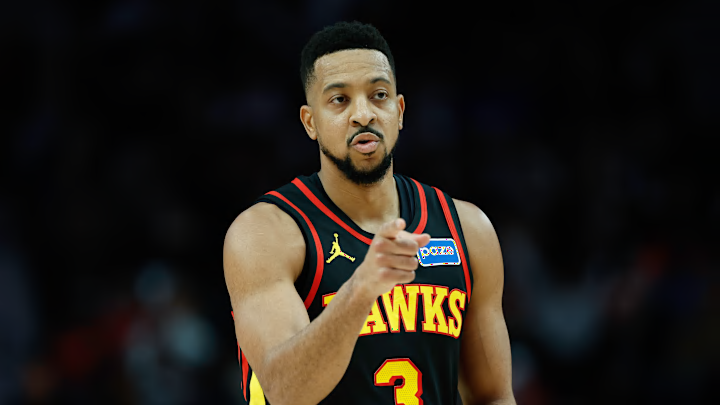
The Atlanta Hawks are facing an inevitable learning curve as they integrate Corey Kispert and CJ McCollum into the rotation. Though both are talented players, they've changed scenery mid-season and are thus being asked to adapt to new teammates' tendencies without the benefit of training camp.
What the early return on the stunning Trae Young trade has revealed, however, is that fit is in fact more important than talent.
On paper, there are few arguments in favor of trading a four-time All-Star who's 27 years of age for a 34-year-old scorer and a 3-and-D wing. The reality of what Atlanta has achieved, however, is more than just addition by subtraction by parting ways with a star who no longer fit their identity.
McCollum has effectively provided the Hawks with a blueprint for the type of veteran guards they should be prioritizing to help get the team over the top.
Kispert, meanwhile, has been a coveted player for several years due to his efficient shooting and size along the wings. He's generally been regarded as a plug-and-play option who can fit whichever system he's asked to due to his willingness and ability to play off of ball handlers.
By replacing a ball-dominant point guard who no longer fit the free-flowing nature of the Hawks' offense with two players who can operate both with and without the ball, the true potential of this team will be realized.
Hawks wisely prioritized off-ball value in Trae Young trade
The Hawks have responded to a recent four-game losing streak by winning three straight. That started with a 124-122 road win over the Memphis Grizzlies, during which McCollum had 15 points and six assists in 26 minutes.
It was followed by consecutive victories during which McCollum scored at least points 21 points despite attempting just 15 shots in each outing.
It's perhaps the most intriguing trend, as McCollum has exceeded 15 field goal attempts just once with Atlanta. Despite that truth, he's averaging 18.0 points per game and has managed to find success without being particularly dominant on the ball.
McCollum certainly hasn't been playing a low-usage role, but his willingness to work without it has fit a system that's all about sharing the ball.
Ball is flowing more freely and more Hawks are getting involved
During Kispert and McCollum's first eight games, four different Hawks have attempted at least 12.6 shots per game and a fifth, Dyson Daniels, checks in at 9.9. Atlanta has produced a team-best offensive rating of 114.8 when McCollum has been on the court, as well as a net rating of plus-7.7.
Atlanta has also ranked No. 3 in assists points created, No. 4 in assists, and No. 11 in passes made per game during that eight-game stretch.
If the current trends hold, then McCollum should prove to be an absolute net positive for the Hawks moving forward. His careful shot selection, well-rounded skill set, and unselfish approach can unleash the potential of the players around him and the team at large, while Kispert can be plugged in with ease.
As the season progresses, expect the Hawks' offensive flexibility to reveal just how dynamic this team is capable of becoming.
 Add us as a preferred source on Google