

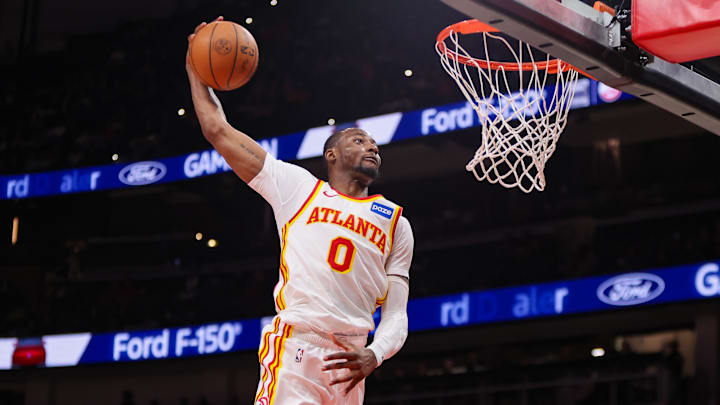
The Atlanta Hawks spent the final seasons of the Trae Young era attempting to recreate the magic of the 2020-21 campaign. It was an understandable strategy after procuring the franchise's second Eastern Conference Finals appearance since 1970, but it also resulted in the Hawks playing it too safe in regard to swinging for the fences on talent with upside.
In the immediate aftermath of trading Young, the Hawks proved how drastically their ideology has changed by taking a chance on polarizing forward Jonathan Kuminga.
The Young era was rewarding, but it also became a constant battle to mask his defensive flaws and find players who were willing to adapt to a ball dominant star teammate. That ultimately shrunk the talent pool from which Atlanta could pull its contributors.
With Young traded to the Washington Wizards and Jalen Johnson operating as a two-way player in the star role, however, the Hawks are acting with far more flexibility.
Hawks are finally gambling on talent with untapped potential
A case can be made that Johnson is proof that the Hawks were always willing to invest in promising talent, but he was the No. 20 pick in the 2021 NBA Draft. As such, he's more of a testament to the team's ability to develop talent than its willingness to take chances.
For that matter, even the trade that landed reigning Most Improved Player Dyson Daniels was initially perceived as being centered around the two first-round picks Atlanta received for Dejounte Murray.
The trade for Kuminga, however, was all but exclusively about bringing his talents to Atlanta—a refreshing change of pace for a team that too often refused to gamble on unrefined talent. As fate would have it, Kuminga has hit the ground running in an environment that has encouraged him to be himself.
Through his first three appearances, Kuminga has averaged 21.3 points, 7.7 rebounds, 3.3 assists, 1.7 steals, and 1.7 three-point field goals made in 26.7 minutes per game. Though a three-game sample size proves virtually nothing, he's played to his strengths and operated as a player who can attack the rim both with and without the ball.
Had Young still been in Atlanta, it's fair to question if the Hawks would've made the same trade or produced these type of promising early results.
Hawks escaped limitations of catering to Trae Young's style, weaknesses
Kuminga is talented, but his inconsistent three-point shooting and need for frontcourt touches may not have been an ideal match for Young. Young is an incredible passer, but Kuminga's success has been driven in large part by the free-flowing nature of Atlanta's offense.
With Young on the court, the ball tended to stick with him until he made the read for a shot or pass—an approach that wasn't necessarily conducive to maximizing isolation scorers' growth via repetition.
Thankfully, Atlanta is no longer basing its roster decisions on just one player. It's assembling a talented team around a malleable talent in Johnson and is trusting a deep cast of scorers and playmakers to excel, including Nickeil Alexander-Walker, Kuminga, and CJ McCollum.
Though it may not be a change that's truly understood until an offseason or two have passed, the Hawks' shift away from catering to Young has resulted in a more dynamic approach to team building.
 Add us as a preferred source on Google