

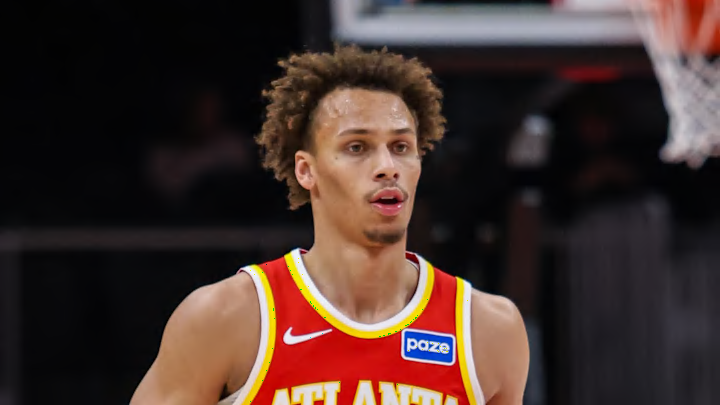
Dyson Daniels unexpectedly assumed a large playmaking role this season when Trae Young went down during the Atlanta Hawks’ fifth game of the season. The team deployed a starting five devoid of a traditional point guard in Young’s absence, leaving Daniels as one of the lead playmakers for the squad.
Daniels has always been a strong playmaker, but he’s never been asked to be the lead guard for a team. Before the draft, he played for the G League Ignite alongside future top-3 pick and point guard Scoot Henderson, then he joined a New Orleans bench unit featuring Jose Alvarado. This was the ideal developmental scenario for Daniels, as he was allowed to receive reps as a playmaker without being forced into a role he wasn’t ready for.
Similarly, this year’s sudden elevation to the lead playmaking role was the logical next step for Daniels’ progression. After spending 17.0% of his time with the ball in his hands last year (49th percentile for SGs), he upped his on-ball rate to 21.8% (84th percentile) – a fitting increase for a man who just earned a $25 million annual salary.
Daniels instantly thrived in his increased role, yet still managed to improve
He handled the added responsibilities well, dishing out 2.1 more potential assists per 100 possessions (78th to 94th percentile) and creating 5.0 more points off assists per 100 (67th to 97th percentile).
This increase in usage, however, came with a drawback: Daniels was turning the ball over too much. His turnover percentage over the first three seasons of his career decreased from 20.2% to 15.0% to 13.6%, then spiked in the first month of the 2025-26 season to 20.0%. Consequently, the Hawks struggled to take care of the ball as a team after losing Trae Young’s ball security.
But Daniels has steadily worked turnovers out of his game. After a turnover-prone November, Daniels decreased his TOV% to 14.3% in December, then 11.3% in January, and 10.8% in February. While the month of March is still underway, he’s decreased his TOV% to a new low: 8.7%.
Daniels’ in-season improvement is a testament to his basketball IQ and potential in his unique archetype. Learning on the fly, Daniels managed to significantly increase his usage as a playmaker while simultaneously taking better care of the ball than he ever has in his career.
Thanks to his brutal shooting slump, the casual NBA fan may think Daniels is a negative offensive player. Indeed, his 12.9% clip from three is not pretty, but he has become an integral part of a quietly good Atlanta Hawks offense by becoming a true point guard. The Hawks lead the league in assists per 100 possessions; without Daniels, the offense would not flow as organically as it has this year.
 Add us as a preferred source on Google