

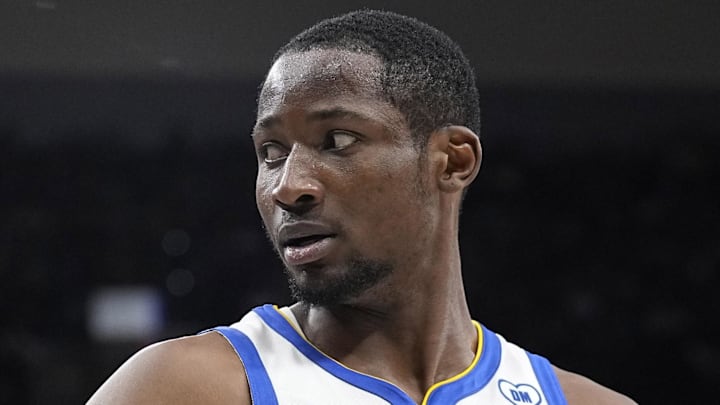
The Atlanta Hawks shocked (and confused) the world when they traded Kristaps Porzingis to the Golden State Warriors for Jonathan Kuminga and Buddy Hield. How we look back at this trade depends on one critical decision Onsi Saleh must make this offseason.
While the trade was stunning at first glance, a Porzingis-Kuminga swap makes sense in hindsight; both players were assets their respective teams needed to move on from.
After Atlanta picked up Porzingis, he would play in less than 33% of possible games. Given that the Hawks are, in Onsi Saleh’s own words, building for the future, it made sense to convert the 30-year-old Porzingis into a young asset.
In Golden State, tensions between Kuminga and the organization had reached a breaking point. Steve Kerr admitted he is at fault to some degree, although many also point the finger at Kuminga for poor effort and a toxic locker room presence. Whatever the truth is, one thing was clear: both parties needed to move on.
There is essentially no cost to losing Porzingis, as he was never going to be a part of the next great Atlanta Hawks team. Still, this trade could prove to be a disaster if Onsi Saleh does not exercise caution this offseason.
Onsi Saleh cannot extend Kuminga to a reckless extension
Kuminga was in the league’s ugliest contract dispute last offseason (except for perhaps Cam Thomas). He clearly did not want to remain a Warrior, but there were no suitors willing to outbid the club for the restricted free agent. He ultimately signed a two-year, $46.8 million deal with a team option for next season.
Onsi Saleh has three paths forward with Kuminga next season. Only one of them will make this trade a success.
The worst possible outcome is that Saleh declines Kuminga’s option to re-sign him to a long-term contract. While Kuminga has the potential to be an impactful player for Atlanta, nothing he has done over the past three seasons suggests he is worth a long-term deal. Given Saleh’s refrain of “optionality,” however, I find it exceedingly unlikely he breaks the bank for an unproven 23-year-old prospect.
The second-worst outcome is that Saleh picks up Kuminga’s option, paying him $24.3 million next season. While there are no long-term consequences of a one-year overpay (which was my justification for the Luke Kennard overpay), this still removes significant money from Atlanta’s possible cap space. This would eliminate Saleh’s goal of finding the next Nickeil Alexander-Walker in free agency.
The best path forward – although perhaps an unrealistic expectation – is that Saleh declines the option and re-signs Kuminga to a relatively cheap one-year deal (say, $10-15 million). In this case, Atlanta again takes no long-term risk while also keeping cap space. Furthermore, by declining the option and only then re-signing Kuminga, Saleh could go over the cap using Bird rights. This would allow Atlanta to be as aggressive as possible without adding long-term risk.
I have faith that Kuminga can be rehabilitated into a solid contributor in Atlanta, but this is no guarantee. For this reason, Saleh cannot afford to extend Kuminga to a long-term deal, no matter how well the G League Ignite product plays.
 Add us as a preferred source on Google