

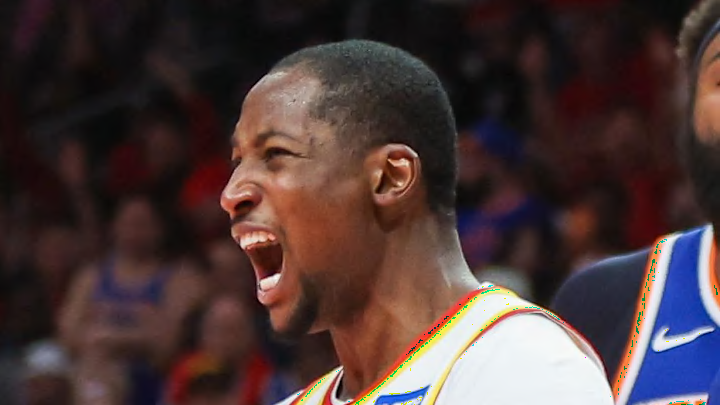
What a year it has been for the Atlanta Hawks.
When the Hawks traded Trae Young and Kristaps Porzingis—a franchise legend/All-NBA offensive engine and an NBA champion/All-Star center—everyone assumed the team planned to take a step back.
With Jalen Johnson budding into an All-Star, Nickeil Alexander-Walker playing at a Most Improved Player Award level, and Onyeka Okongwu breaking out as one of the better centers in the league, Atlanta had the building blocks to move forward, but the team would certainly require an influx of talent to be competitive in the playoffs.
Right?
Well, apparently they didn’t. Young’s replacement, CJ McCollum, had a true breakout season after finally landing on a team that fits his playstyle (which sounds strange in reference to a 34-year-old). Porzingis’s replacement, Jonathan Kuminga, has had his own (more predictable) breakout season, going from DNP-CDs in Golden State this season to making the game-winning defensive play to put his team ahead in a playoff series.
Talk about a change in the narrative.
McCollum is finally freed from the ridiculous responsibilities
No longer is McCollum playing alongside another guard with questionable defensive chops (Damian Lillard), nor is he asked to play point guard, as he was in New Orleans and Washington. Instead, the Hawks are simply asking McCollum to do what he does best: score the ball.
The result? CJ ranked in the 91st percentile of two guards in Darko DPM and points per 100 this season. His ORAPM ranks even higher (97th percentile), substantially improving Atlanta’s overall true shooting and turnover margins. The stats paint an overwhelmingly clear picture that McCollum has not just been an adequate replacement for Young, but is one of the team’s best players.
He’s proven to be just as effective in the postseason, averaging 27 points, 2.7 assists, 3.7 rebounds, 1.3 steals, and 1.3 blocks through Atlanta’s first three playoff matches against the New York Knicks.
Atlanta currently leads the Knicks 2-1, and McCollum could not have played a more vital role in these victories. In both wins, McCollum scored the go-ahead shot in the final minute of the game, scoring a tough mid-range leaner to break the 103-103 tie with 33 seconds left in Game 2, and an even more difficult stepback mid-range fadeaway to put the Hawks up one with 14 seconds to go in Game 3.
When McCollum was traded to Atlanta, I called the trade a fair deal for Atlanta due to moving on from Young’s salary without having to fork over any draft capital. In hindsight, McCollum for Young looks fair on talent alone, with the financial flexibility gained simply being an additional bonus.
Kuminga is finally freed from the dysfunctional dynasty
While McCollum’s resurgence seemingly came from nowhere, Kuminga’s breakthrough was much more predictable.
Drafted by Golden State in 2021, Kuminga won a ring in his rookie campaign. He rode the bench for the majority of the playoffs, but when Draymond Green missed three games, Kuminga filled his shoes admirably in the starting lineup. He certainly had strides to make as a player, but Kuminga’s future appeared bright.
And indeed his future was bright—at least for three seasons. When Kuminga and the Warriors failed to reach a contract extension heading into his fourth year, something went left. Warriors sources will claim Kuminga showed a concerning lack of buy-in, while reports from the player’s camp would tell you head coach Steve Kerr pushed the budding star away.
Regardless of who was justified in this beef, Kuminga had an awful 2024-25 campaign by his standards, and 2025-26 didn’t start much better.
Kuminga had a hot start in a Hawks uniform and firmly established himself as the club’s microwave-scoring sixth man heading into the playoffs. For him to be successful in the postseason, however, Kuminga had to do more than just score the ball.
Fortunately, Kuminga has displayed a well-rounded skill set against the Knicks. The Hawks’ defensive rating is remarkably better with him on the floor (29.0 points per 100 better; 2.2 points per 100 better when padded to account for the small sample size). Perhaps his most important contribution has been on the glass: when Kuminga plays, the Knicks’ offensive rebounding rate declines from 36.7 to 22.9, a 38 percent decrease.
Had the Hawks botched the Young and Porzingis trades, the franchise could have ruined any chance of salvaging the Jalen Johnson era. The team would have been stuck in basketball purgatory: too good for a top pick, not good enough to be a real playoff threat, just good enough to keep making the Play-In.
In Onsi Saleh we trust.
 Add us as a preferred source on Google