

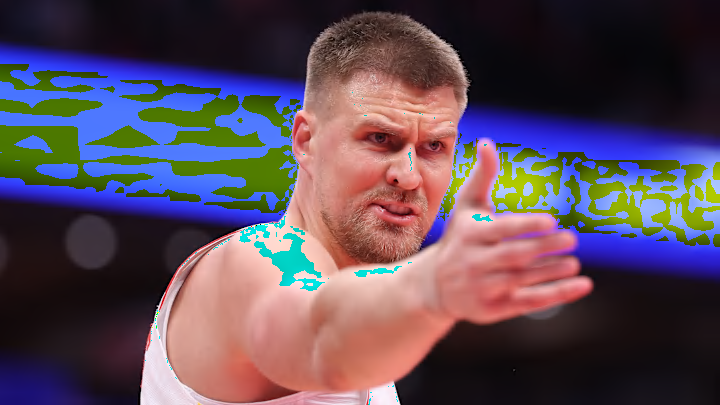
The Atlanta Hawks almost wasted this season, seemingly for no reason, by not signing a proven third-string center.
Their hesitance to find a third big with real NBA experience was mind-boggling at the time and remains my biggest criticism of Onsi Saleh’s brief tenure as lead executive. The Hawks’ center rotation consisted of Kristaps Porzingis, the league’s most injury-prone player, and Onyeka Okongwu, the league’s shortest center. While both players are excellent options at the five, their respective limitations make it necessary to bring in a third big to stabilize the rotation.
Atlanta technically signed N’Faly Dante to back up Porzingis and Okongwu, but Dante had played just four NBA games in his career. Two months into the season, Dante tore his ACL. When paired with a series of absences from Kristaps Porzingis, Atlanta was left with a hopeless lineup.
If you recall, the Hawks were a massive success story at the beginning of the season. Despite losing Trae Young in just their fifth game, Atlanta peaked as high as third in the East. There isn’t one area to credit for this rise – the team was just playing beautiful basketball. The ball was zipping on offense. Bodies were hustling on defense. Most importantly, the Hawks’ youthful rotation was outhustling their opponents.
After cruising to an 11-8 record, Porzingis’s health hit a wall. He would play in just six of the next 28 games, and the Hawks predictably floundered, going 11-17 over this stretch.
All it took to reverse Atlanta’s fortune was a legitimate center
Make no mistake – Porzingis is an excellent player whose absence significantly alters this team’s outlook. Still, the team’s record has dropped by 19% over the past 28 games. This isn’t all Porzingis’s doing; part of the problem is that Atlanta just needed a center.
Asa Newell and Mo Gueye split backup center duties from December to mid-January, with limited success from both players. Newell particularly struggled as a 20-year-old rookie who hasn’t quite grown into his body yet. After months of watching, Saleh finally took action by signing Christian Koloko off the waivers.
Koloko is a good player whose career was tragically derailed by blood clots that forced the Cameroonian big man to prioritize his health. He isn’t some superstar, however – in fact, he was already waived twice this season. He specializes in the basics: boxing out, setting hard screens, filling the paint, and applying vertical contests at the rim.
Still, in Koloko’s two-game tenure, the Hawks are 2-0. While this is a small sample size, Atlanta’s biggest problems immediately solved themselves by just playing a real center.
This instant impact makes you wonder, however, if Atlanta’s struggles this season could have been avoided. Why didn’t Saleh sign another center in free agency? They had an empty roster spot and plenty of cap space via exceptions.
Would the Hawks have gone on their infamous seven-game losing streak if they had a center ready to play when Porzingis missed time? Would vibes have cratered as badly as they did, leading to a players-only meeting in December? Would they have felt forced to trade Trae Young for scraps if the team had a winning record?
We’ll never know the answer to these questions, but we have learned one thing: Saleh’s refusal to sign a third center was the first mistake of his young career.
 Add us as a preferred source on Google