

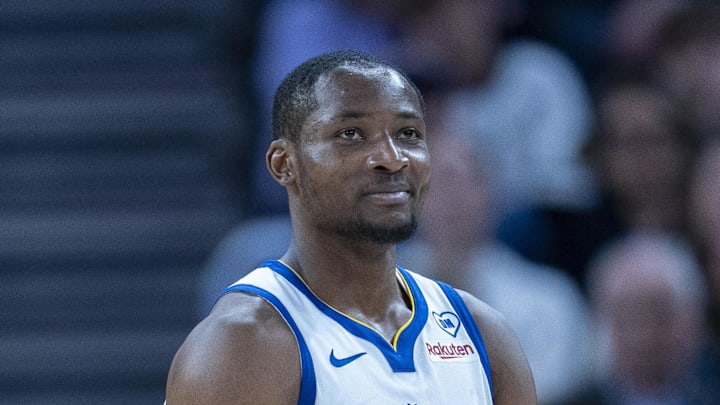
Atlanta Hawks GM Onsi Saleh views Jonathan Kuminga as a power forward, not a small forward, as he has traditionally played. If this is indeed how the team employs their newly acquired former top-10 pick, Kuminga could have quite the bounce-back season.
Kuminga at the 4 makes a lot more sense than at the 3, particularly if ATL prioritizes stretch 5s to support Jalen Johnson.
— Sam Allred (@Smallred25) February 10, 2026
Suddenly his shooting struggles are no longer as big a concern, and similar players with low defensive motor (ex harden) have thrived guarding up https://t.co/pw6owXS7lD
Kuminga has an interesting game, with elite athleticism and strength at 6’7. He sees himself as a bully-ball offensive creator who lives in the restricted area, and his statistical profile reflects this image. He was in the top quarter of small forwards last season by rim field goal attempts and rim efficiency, but his effectiveness quickly tapers out beyond floater range.
In the modern NBA, small forwards must be able to shoot the rock. Kuminga, a 28th percentile three point shooter for his position, does not count this as one of his strengths. On a team starring Jimmy Butler, Draymond Green, and a non-shooting center, Kuminga’s lack of spacing posed serious problems to the Golden State Warriors.
At the four, however, the expectations for his shooting are much lower. Even better, the Hawks already have a shaky shooter at power forward, Jalen Johnson, who the team is committed to pairing with a stretch five. If the Hawks plan to play a stretch five and limit the time Kuminga and Johnson share the floor, suddenly Kuminga’s poor shooting isn’t nearly as big a problem.
Was Kuminga a power forward all along?
Playing the four wouldn’t just hide Kuminga’s poor shooting; it might allow him to be a better defender.
Despite his elite athletic traits, the G League Ignite product has never registered as a positive-impact defender by DARKO. In fact, his defensive peak was the 287th-best defender in his sophomore season – he hasn’t placed in the top 400 in DDPM in his other four seasons as a pro.
Whether it’s his motor, lateral quickness, or defensive IQ that has limited his defensive impact, playing up a position would ostensibly help in this department.
Take James Harden and PJ Tucker as examples. Both players are quite hefty for NBA athletes yet were underwhelming defenders early in their careers. In 2019-20, the Houston Rockets employed a bold “zero big man” strategy, starting the 6’5 Tucker at center and assigning Harden, also 6’5, on opposing PFs.
Miraculously, these two were both better defenders in their new roles despite their massive height disadvantages. Their physical strength, combined with their low center of mass, made it impossible for taller opponents to move bully them in the post. By playing up, the pair of players also mitigated their lack of quickness. While this is an unconventional strategy that won’t work for most players, it's a smart move for low-motor, high-strength players to maximize their unique skill set.
Kuminga is one of these players who fits this mold. If Quin Snyder follows Saleh’s advice, expect Kuminga to have more success than previously seen before.
 Add us as a preferred source on Google