

History's greatest tacticians, generals, and commanders all have one thing in common: they learn from the mistakes of their predecessors.
While Onsi Saleh may not have the weight that Alexander the Great, Hannibal Barca, Julius Caesar, or Napoleon Bonaparte did while they waged their respective military campaigns, the same principle of leadership applies: learning from past inefficiencies and resisting the temptation to repeat familiar roster-building mistakes.
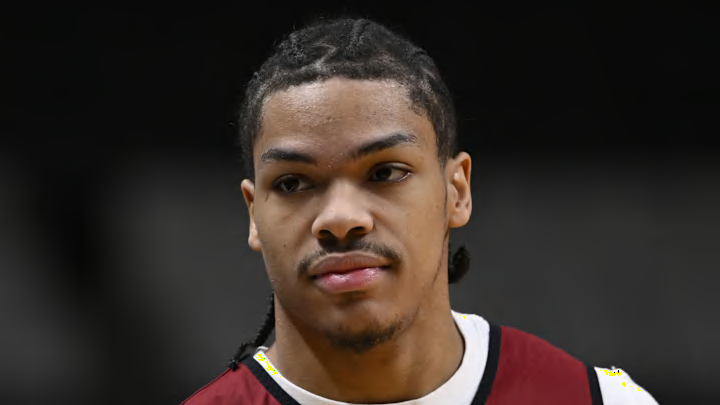
Drafting Darius Acuff would be all too familiar of a mistake in the 2026 NBA Draft, and Atlanta has many reasons to steer clear.
Atlanta's history with small guards suggests another draft day direction
Only a year into his time as GM of the Hawks, Saleh has already demonstrated a proficiency in avoiding rostering small guards, even if their offensive talents are well, well above league average.
Yes, I'm talking about Trae Young.
While the Young years were chock-full of entertaining basketball and year after year of him leading the league in the assist column, they didn't contain a great deal of meaningful winning when it mattered the most—the NBA Playoffs.
Trading away Young in January for CJ McCollum has already proven to be a vastly shrewd move by Saleh, both saving the Hawks ample amounts of cap room, as well as beginning the post-Trae playoff era with a bang rather than a whimper.
The Hawks have completely reversed this trend so far in the 2026 NBA Playoffs, as we sit in the middle of a highly competitive series with the Knicks—a situation not anticipated by many experts.
Only four games into the first Trae-less playoffs, the Hawks have managed to hold water in an uphill battle against the higher-seeded New York Knicks, in large part due to their exploitation of the Knicks' very own small guard: Jalen Brunson.
Brunson's weaknesses prove the same point rostering Trae Young did
Atlanta has relentlessly attacked Jalen Brunson through four games, using their size and strength to bully the smaller Brunson in the paint, yielding a great deal of success early on in the series.
Brunson's Knicks have seen a greater deal of success than Young's Hawks, in large part due to New York's willingness to expend a great deal of resources to build around him.
Trading five first round picks for Mikal Bridges was the cherry on top for a franchise that actively sought out physical wings like OG Anunoby and Josh Hart to mitigate Brunson's defensive weaknesses. While it's resulted in more wins than losses, the Knicks were absolutely forced to go all-in, thanks to Brunson's shortcomings.
While time will tell if Atlanta will emerge victorious in the Knicks series, one lesson is brutally clear— the Hawks should do everything in their power to avoid rostering a Jalen Brunson/Trae Young copycat.
Acuff would demand the same roster construction of Young or Brunson
It just so happens that the Hawks have the current core to nullify Acuff's weaknesses, if they so choose to do so—Dyson Daniels and Nickeil Alexander-Walker are incredibly similar to OG Anunoby and Mikal Bridges on the defensive end of the court.
That being said, it shouldn't justify taking Acuff. The Hawks would be much better served selecting a more versatile defender and marginally weaker scorer (e.g., Kingston Flemings) that would both assist the Hawks on defense, as well as share the ball effectively on offense, a la CJ McCollum.
If the NBA Draft Lottery doesn't shake out Atlanta's way en route to a top-four pick in a few weeks, look for Saleh to continue his trend that he began by trading away Trae Young—seeking out versatile pieces that don't present issues in the NBA Playoffs, when it matters the most.
 Add us as a preferred source on Google